Julia Bello
Key takeaways
- 11:16A decision-making tree can organize products by subcategory, type, price segment and other imported or system-created attributes before assortments are optimized by store or cluster.
- 13:20A strategy that may require some category managers about three days to build manually can be calculated by the demonstrated system in roughly one minute.
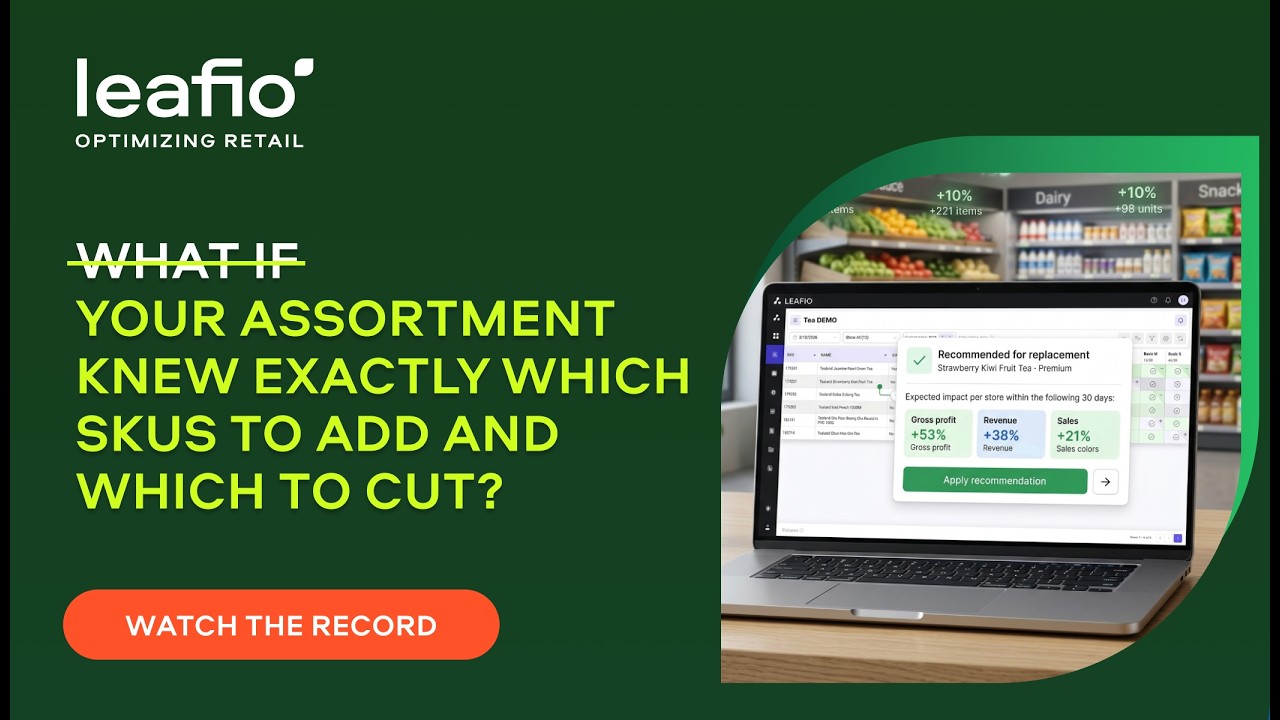
- 17:23The engine produces three actionable recommendation types—SKUs to add, SKUs to remove and SKUs to replace—based on the selected strategy and business rules.
- 22:28Assortment recommendations are space-aware, helping prevent category managers from listing products that cannot fit on a store's available shelves.
- 38:46Strategic limits can require at least one SKU in a segment or protect selected products from removal even when their direct sales performance is weak.
Questions Julia Bello answered
Yes. Clusters can use available indicators and descriptive attributes, including regions or store groups, although LEAFIO generally recommends using no more than about five parameters to keep the cluster structure understandable.
Webinar: How to Eliminate Revenue Loss from Missing Items25:31
Yes. Recommendations account for shelf capacity, while manual assortment changes can be checked against capacity, supplier rules and the approved strategy before a SKU is added.
Webinar: How to Eliminate Revenue Loss from Missing Items27:34
Custom roles and permissions can give store managers limited access to assortment matrices and communication features while hiding sensitive dashboards or analytics. Access can also be restricted to particular stores or pages.
Webinar: How to Eliminate Revenue Loss from Missing Items31:40
Yes. Strategic limits can require products or segments to remain represented, creating boundaries within which the recommendation engine operates; otherwise, teams can choose to follow the performance-driven recommendation.
Webinar: How to Eliminate Revenue Loss from Missing Items36:45
In Julia Bello's words
“Those recommendations take into account the capacity of stores.”
Webinar: How to Eliminate Revenue Loss from Missing Items22:28